
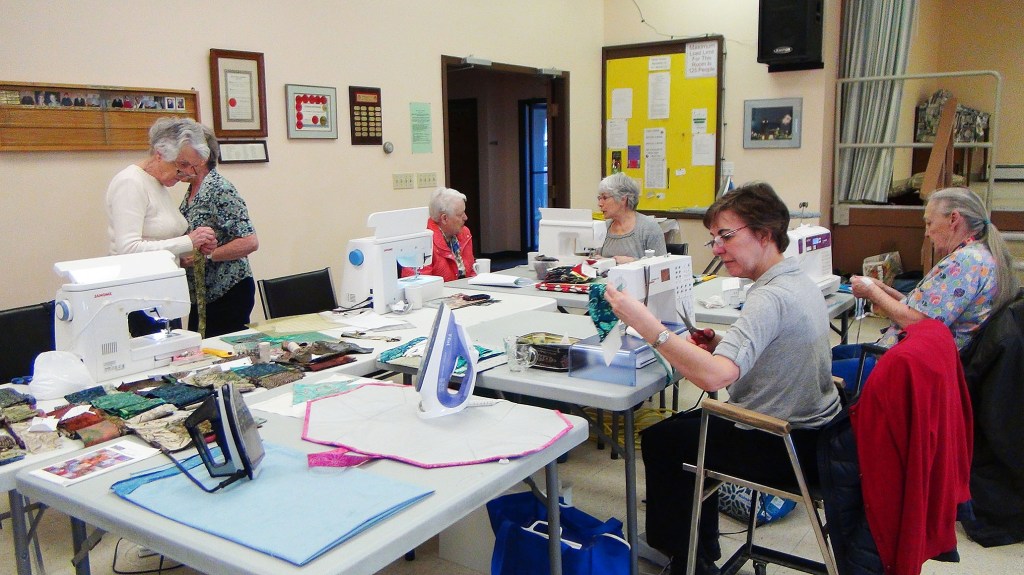
Gallery Below (left to right): Canadian Feminism –Wiki commons; Members playing a quilting game,“Strip Poker,” at a program night. Front table: L around – Betty Young, Ingrid Carlgren vs. Sandra Martin. Linda Wesley, Wendy Hogg; Background – Susan Little, Carol Patton, Mary Lindguist, Unknown and Ilene Lowing – All images courtesy of CQG.


1980s and the US Bicentennial
Canada’s centennial celebrations and quilt competitions of 1967 had already fostered quilters to branch out from the more traditional quilt style made for wedding gifts into the more pictorial quilts needed to fit the competition theme. A local Cranbrook quilter, Hilda Pingatore, entered the BC Centennial Quilt competition, as was advertised through the vast newspaper industry of the age. Sadly, there isn’t a picture of her second-place winner.
At this time, the feminist movement was touching the consciousness of many Canadian women. And with this came the realization that art creations often took the form of needlework, including quilting for women. In this vein, fabric and quilts offered a wide scope. Today, “art quilts” are a big part of the entries displayed in Quilt Canada’s Bicentennial National Juried shows (Conroy).


As 1980 loomed, the feminist movement had championed needle art as historically “women’s art,” and the green movement elevated the appeal of quilting as “potentially eco-friendly” and the widely reported American Bicentennial in 1976 had spurred hundreds of quilters to create quilts that spoke to the centennial themes.
It is this event, the US bicentennial, that our guild members speak about as sparking the interest in quilting locally. “Quilters Newsletter” (1969-2016), the “grandmother of all quilt magazines,” had a Quiltmobile that they drove across the US in 1976, exhibiting quilts, teaching quilting, and heightening interest in the craft. Their efforts likely spurred many of the Bicentennial quilts.
The Modernity of Quilting


The Future of Quilting
Modern day quilting has changed. The movement in 2024 is away from the practical and the traditional bed quilt. Many quilters are making smaller “home decor” items such as table toppers, placemats, and bags of every size and description. The hues of the modern colours are different: yesterday’s Christmas red isn’t today’s Christmas red. Some guilds have split into a group that use patterns more traditional in design and colour and a “modern quilt guild (MQG)”.
One definition of an MQG is: modern quilts go off the grid and use asymmetry, less fuss, minimalist designs and a more improvisational style with an unusual arrangement of flocks and setting. Our guild members play with both traditional and modern designs.
 CranbrookQuiltersGuildHistory