

Membership numbers fluctuated from 24 at the beginning to 40 after the first five years, then to 60 and 95 in 2014-2016. They are now settling at 60, though some of the 60 are “supporters” of the guild rather than active participants.
In the beginning, all members were similarly aged and at about the same stage in their quilting journeys—30 to 40 and a seasoned beginner, with a few very skilled quilters. Learning to quilt was the focus. Most finished their quilts by hand-quilting the layers. Quilts consist of a top/flimsy, a middle layer of batting, and a fabric backing that makes a quilt when sewn together by hand or by machine.
Now, the guild members meet the recently published descriptor:
Snapshot surveys – both in the UK and the USA – indicate that the average quilter is in her (the vast majority of quilters are female) early to mid-sixties, has been quilting for several years (most as a hobby but some as a profession) and lives in a household with an above average income.
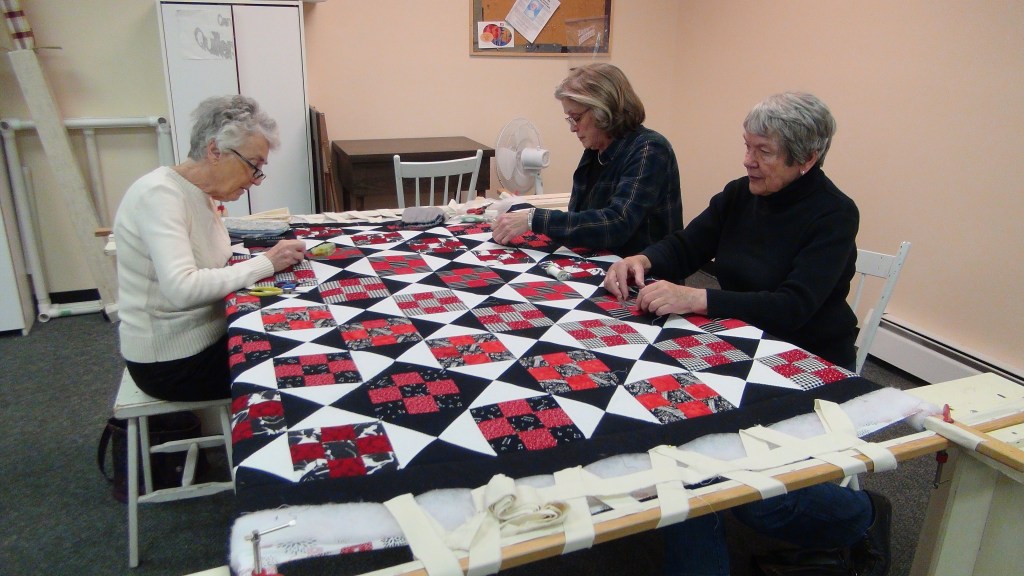
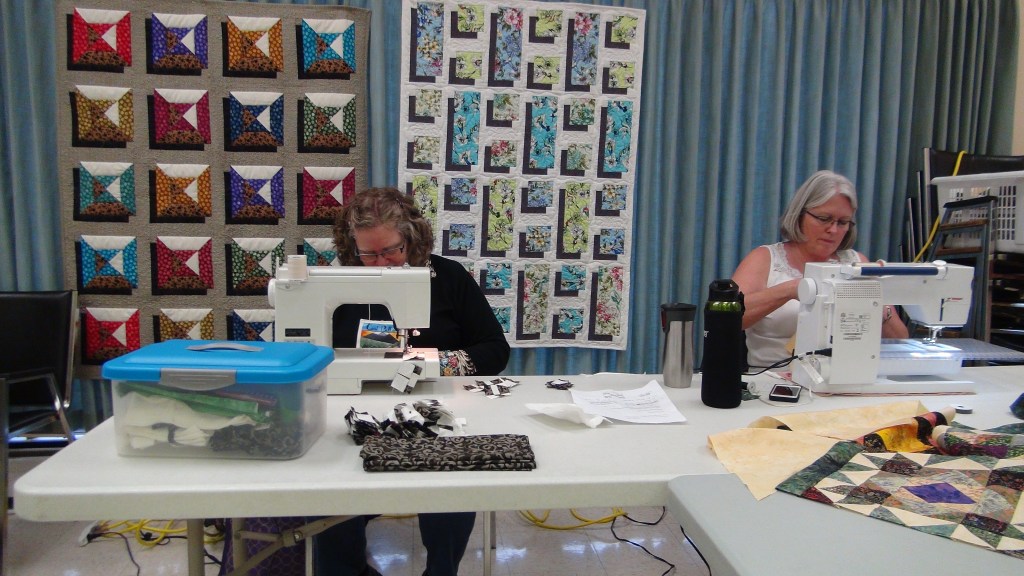
Indeed of the 60 members of the Cranbrook Quilters Guild 2024/25,48 or 80% are over 60, with 17 being over 80. Three are original members, and another two started in 1987. Only four of our members have jobs. Twelve are widows. And most members “send” their bigger pieces to a “longarmer” to quilt.
As one member says, the longarmer puts their art on top of yours. Indeed, using a longarm quilting machine to “quilt” the quilt is a field of quilting that appears to have attracted men to quilting – the evidence for this is on the internet and YouTube. Now, hand-guided longarm quilting machines (sit-down or frame) are becoming common, even for ordinary quilters. Eleven of our 60 members have such machines. Quilt Canada, CQA’s national show, has a category for both hand-guided and computer-guided machine quilting. Hand-quilting is becoming a dying part of the art of quilting.
These demographics change the character of the organization and its capacity. The focus in our guild has shifted away from learning to quilt, workshops, and even quilt shows to the social and community aspects of guild membership. As Barbara Burman, a textile historian wanting to raise the appreciation of sewing, says: “Sewing offers a sense of community, real or virtual, and brings otherwise disparate people together through common interests and aspirations.” She goes on to detail the significance of “plain stitch” sewing crafts. Quilting is one of the “plain stitch crafts,” unlike other needlework like embroidery.
Governance

In terms of our guild’s founding story to the present, the aging of the members and their subsequent shift in interests and work capacity are causing some discord. Mary Lindquist commented that when she joined the guild in 1994, the commitments required of guild members caused her distress as she was a working mother of four teenage boys.
Like any organization, the guild expects its members to participate and to volunteer to lead, not just to help out. This list of guild committees/positions has been the same since the guild’s beginning and matches what other guilds post on their websites:
– Executive position – President, Vice President, Treasurer and Secretary
– Programs/Workshops
– Publicity – media, website, Facebook
– Newsletter (CQG stopped in 1995)
– Historian
– Library
– Membership
– Sunshine
– Community Quilts – making and distributing (each member is to make or help make one a year)
– Quilt Show (every two years)
– Hospitality (each meeting and special times)
– Hand quilting
– Regional Conference – participate every two years and host every 8-10
– Ad hoc committees such as Raffle Quilts, History Project, Exhibits

In addition to these formal positions, members are expected to make treats for meetings, workshops and conferences, man the raffle ticket table, set up in local stores, hang quilts at the quilt shows (and bring your husband to help), store quilt frames in your barn, bring a pot for the pot-luck suppers, make a Secret Santa gift. For treats and gifts, store-bought was frowned upon by these creative ladies. Groups develop their ethics – interestingly, it’s similar for all guilds. There was a real sense that the women were creative in all things.
“As a new secretary in 2010, I couldn’t figure out how that guild actually ran. People talked about guild pins; I never knew we had pins. When the Quilt show came along, I was asked to get the rosette for the winning quilt. Again, where was I to get the rosette? It prompted me to develop a document, “Common Practices,” that records the workings of the guild,” said Guild member Susan Little.
Group commitments may be partially why young quilters aren’t joining. It did influence why some practiced members left around 2017-2018. The guild had hit the bane of organizations: fewer members able or willing to take on the big jobs.
The guild met two evenings a month from 7 p.m. to 9 p.m.: the second Tuesday was for business, and the fourth Tuesday was a social and program meeting. In about 1989, they started meeting on Tuesdays from 9:30 a.m. to noon to hand quilt and work on the guild project.
Early in the guild’s history, members understood that they would have to take their turn and assume one of the executive or committee positions. That willingness seemed to be lost about 2009. Minutes from 2009 through to 2023 talk about the difficulty getting people to fill positions, especially programs that require an activity such as a demonstration of a technique or a trunk show for the second Tuesday of every month.
In 2016, the members agreed to try “Many Hands Make Light Work,” where five-member names would be drawn, and those five members were to get together and plan the evening program. Though members agreed, it worked semi-okay for one year but was in difficulty by year two.
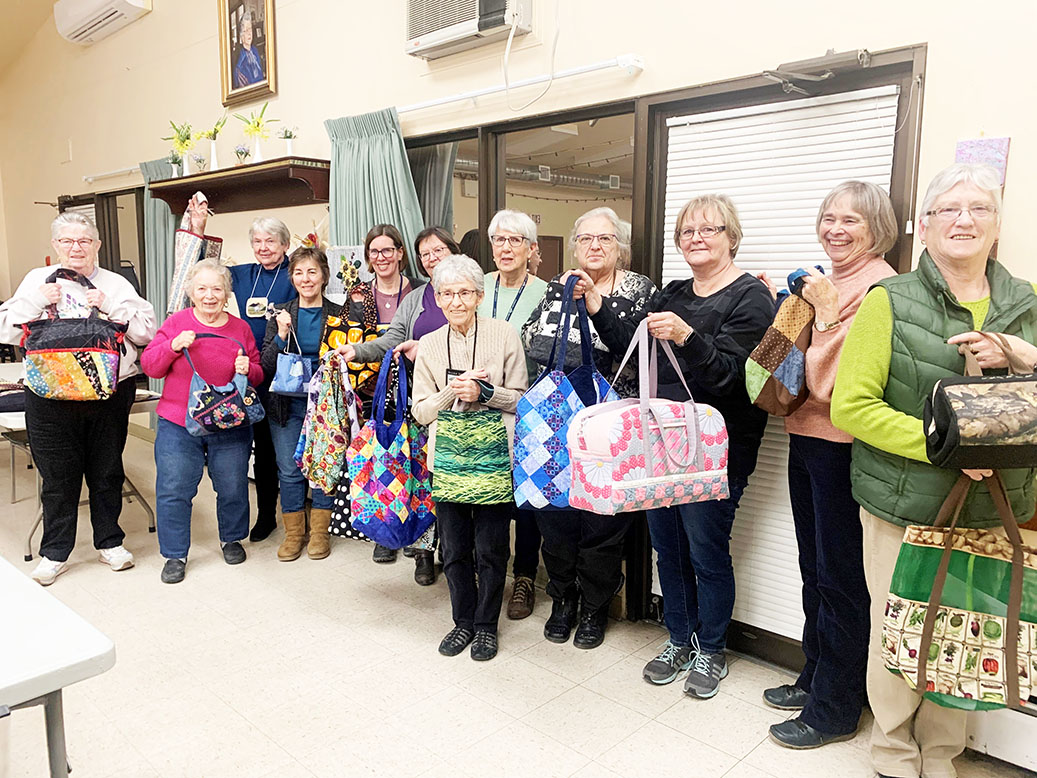
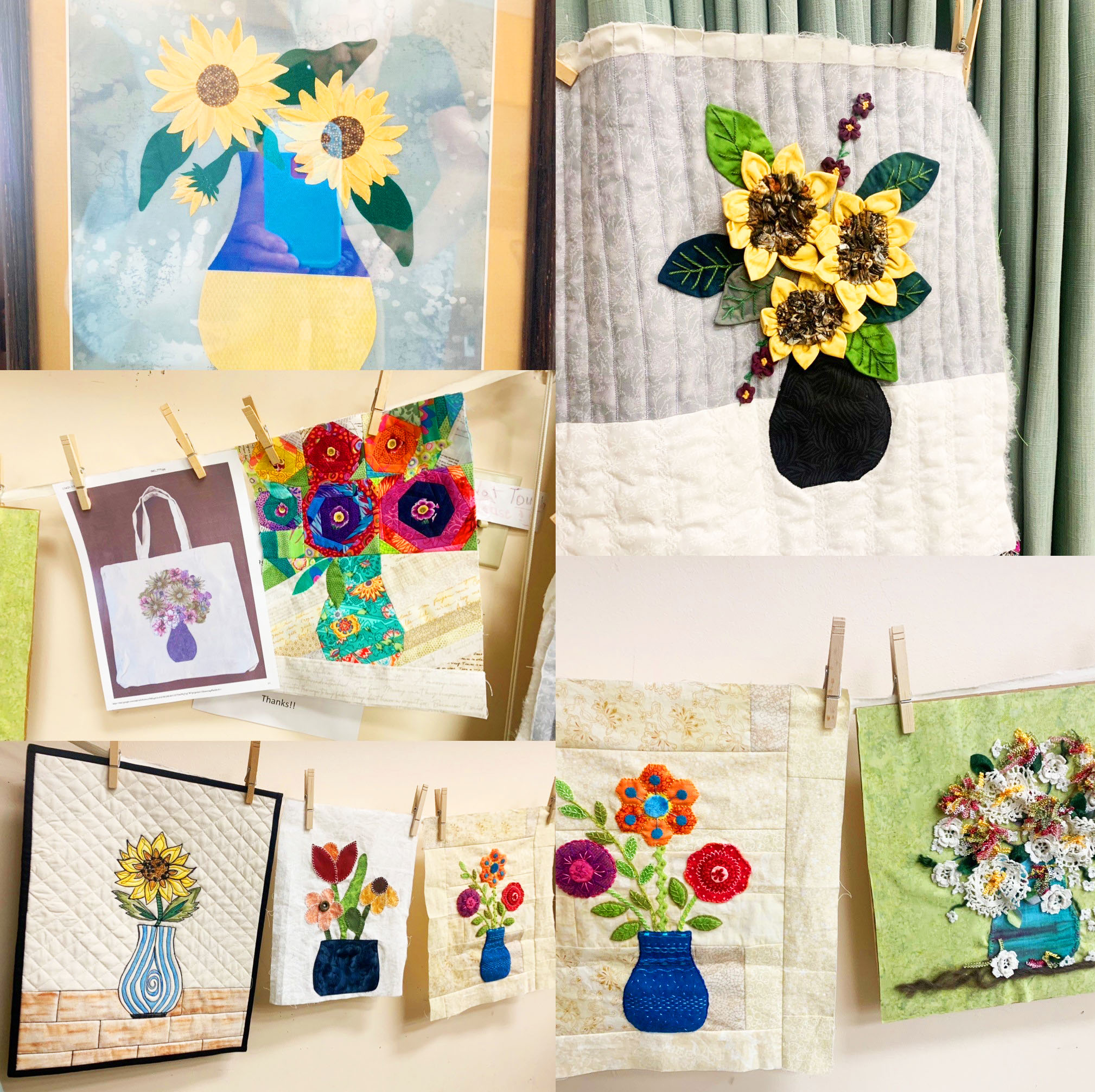
Too many (95 members) preferred to refrain from talking in front of a group for demonstrations. The members needed help getting together, and having a coordinator helped. Yet despite these changes, like the energizer bunny, the basic meeting structure kept happening without the formality of activity “coordinators”. Always someone came up with a program for the second evening meeting of the month, and in-house workshops were planned. We purchased a few “lectures” from renowned quilters and held meetings on Zoom. A member suggested a “Fill the Vase Challenge” and we had an Auction and a “bag” night. Soon, the coordinator was planning the programs.

In response to the Covid 19 pandemic, the guild stopped meeting mid-March 2020 when the government ordered folks to “shelter in place” and to limit contacts to a small “bubble” of family or friends. This would be the first “shut-down” of the guild since its inception in 1985. The planned Kootenay Quilt Conference that Cranbrook was to host that April, was cancelled. Through the rest of 2020 to the fall of 2021, the contact was mainly by email. The executive updated members about the business. The Program Coordinator shared files of show’n’tell photos or on techniques (Manx Quilts, types of bindings). Some small groups met through “Zoom” or “Teams.” And some members took workshops with renowned quilters as these entrepreneurs moved to online classes. Imagine taking a workshop with master longarm quilter Bethane Nemish from Pennsylvania without leaving home and for $70 US.
To resume, the guild needed a new executive as the last group was set to retire in 2020 and 21, though they graciously shepherded the guild through the closure. Quilters are not quitters and always someone steps up. To be a guild with CQA the group needed a President, Secretary, and Treasurer. By acclamation, a President and Treasurer were installed in November 2021. From there, a secretary volunteered in January 2022. The meetings resumed initially on the “Zoom” platform and when allowed and the Guild had a Covid Plan in place at the Seniors Hall, in-person meetings resumed with proof of vaccination, “masks on”, hand-sanitizing, and social distancing observed. This would be another first for the guild: to meet at the Seniors Hall required “proof of vaccination” was a new restriction on guild membership.
The effects were varied: several members chose to retire, some chose to support the guild by joining but not by participating, and others were happy to resume though with a caveat: the guild had become too “formal”, and a relaxation was needed. In that message was another cautionary tale. Many members were from the corporate sector, education, and health care and brought their “work skill sets” to the guild. This coupled with the advances in computer use, created an “official” way of functioning. A lot of “policies” were needed when there were 90+ members. The minutes were perfectly typed and sent by email. Business meeting seating was theatre-style to limit the chattering. There were “rules of order” to follow. Since reconvening the atmosphere eased and the group reclaimed its founding story: to create a forum for quilters to come together to share and learn from each other.
When the group resumed in 2020 after the shutdown for COVID-19, they scraped the program’s position, the workshops, and hospitality. Also, nobody volunteered to be the VP; the only person willing to be the secretary was someone with a full-time job and a home-based business. We reduced the business and tried to get back to the founding story – learning and showing our creations in the show-and-tell part of the meeting. part
of the meeting. Yet despite these changes, like the energizer bunny, the basic
meeting structure kept happening without the formality of activity
“coordinators”. Always someone came up with a program for the second evening meeting of the month, and in-house workshops were planned. We purchased a few “lectures” from renowned quilters and held meetings on Zoom. A member suggested a “Fill the Vase Challenge” and we had an Auction and a “bag” night. And we snacked on Girl Guide Cookies – Susan Little CQG Member
 CranbrookQuiltersGuildHistory