


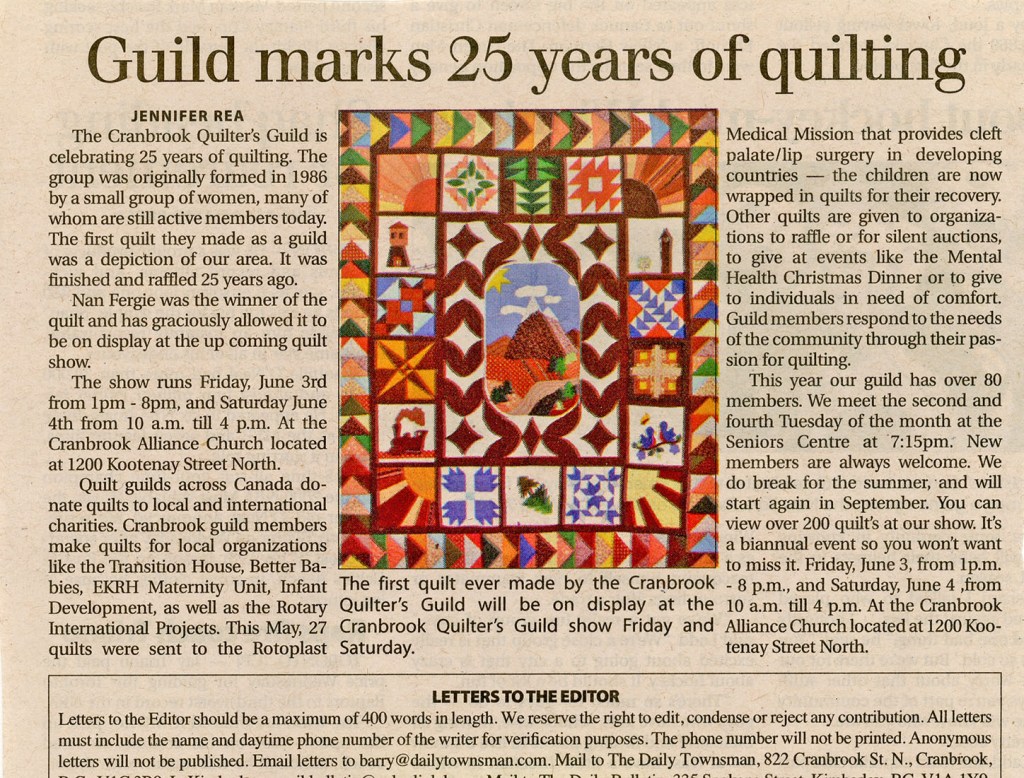
As Juananne Wales, one of the earliest members of the Cranbrook Quilters’ Guild (CQG) following its inception and first meeting on September 24, 1985, wrote:
An essential part of the guild was learning. There were no books, magazines, or YOUTUBE videos when we started quilting. We had a tough time even getting fabric and tools. There were no quilt shops. At the guild, we learned from each other. We would have many workshops, sometimes given by local members but most often given by someone who knew a technique we wanted to learn. We helped each other by basting quilts, as most were hand-quilted. There were no long-armers.
*in 1986, two members, Judy Wright and Linda Shaw, operated a home-based business, Mountain Threads, bringing in notions, fabric and batting.
** Juananne Wales is now a professional long-arm service provider and operator of an online shop, Farm Girl Quilts at farmqirlquilts.ca
History of Guilds and Quilting in Canada

By 1985, the Canadian Quilting Association (CQA) was two years old, having been incorporated in Toronto on April 14, 1983, to give quilters across the nation a vehicle through which they could communicate. Our guild joined the CQA in 1999 on a trial basis. We delayed joining because CQA seemed all about business, and our guild was about quilting as a hobby – said Wales.
From 1987 to 1999, the guild was able to receive a rosette from CQA for the Viewer’s Choice award at the Quilt Shows.
By then, technology for quilting had been significantly advanced, with a simple tool that made cutting quilt pieces a quicker and more accurate process. The tool: Olfa’s revolutionary circular blade rotary cutter (1979) “revolutionized how people cut fabric by switching them from using scissors to rolling a circular blade over the material.”
By the mid-late 1980s, acrylic rulers were added to the list of a quilter’s indispensable tools by replacing the “cereal box” or “Shrinky dinks” plastic handmade templates (6). Along with these two tools came the quilters’ self-healing mats (c Olfa, Omnigrid, and others).
Communication technology was also advancing by 1985 – the home computer was becoming an essential household appliance like a sewing machine was earlier. E-mail and the “net” were starting to be used in workplaces. Magazines were becoming plentiful, and by the 90s, “craft” magazines published in another part of the world would be available in local stores.
Technology
Quilting is a massive industry in Canada and the US. We are now inundated with resources and designs, and access is a simple click away on your digital devices and home computer, whereas, in 1985, there wasn’t a lot of available instruction except through books and magazines. Most magazines were black/white with maybe a coloured centrefold. There weren’t many books/magazines on quilting. (Note – before purchasing equipment, the guild set up a lending library of books. In 87, they set aside $100 and bought a filing cabinet to leave at the Seniors Hall to store the books). In the early years, the guild got Quilters Newsletter and eventually the CQA Magazine. They connected with a group from Japan and received a Japanese magazine from that group – it was a quilters’ magazine. Some members made patterns deciphering the process from the pictures. (JW)
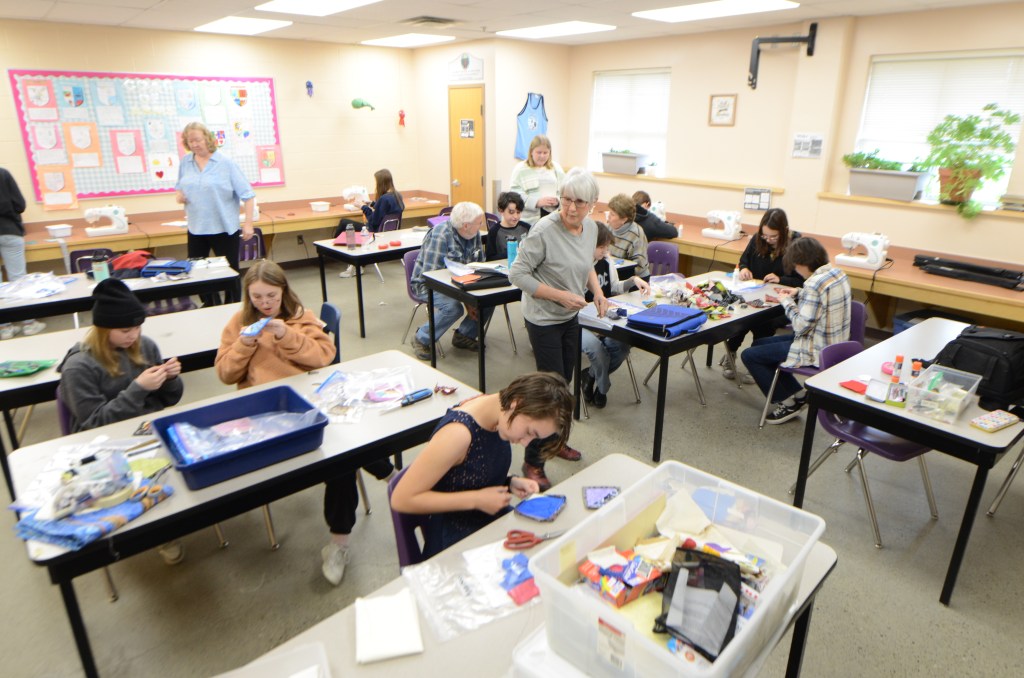
You can make a quilt entirely by hand with simple tools – cotton fabric and batting or flannel, cardboard for templates, scissors, ruler, pencil, needle and thread. We recently taught quilting in the Grade 9 class at Parkland School. Here, we took the students back to the beginning, when a quilt could be made without expensive equipment. We did have the students use a straight-stitch sewing machine, which, for most, was the first time that they had sewn two pieces of fabric together on a machine. This is such a different beginning than the guild members who came from households where sewing was part of everyday life or someone who picked it up in Brownies and Guides or other groups and then finished off with Home Economics in school grades 7 to 12.
Sewing machines for quilting can be simple. Most members have two or three machines—it seems collecting machines accompany collecting fabric and notions. Quilting is plain stitch, meaning all you need is a machine that sews straight forward and the same in a backstitch. And by hand, you need to know a running stitch and a slip stitch.
While the rotary cutter is still the most indefensible tool, now an “automatic” cutter is modelled after industrial machines. AcuQuilt machines have a roller system where the fabric is placed on a disk with embedded cutters, and the fabric and disk are fed through the machine. The claim is “more accurate cutting”. The guild was gifted a cutter by Judy Denny’s family. In addition, many companies do the cutting for you and market jelly rolls, layer cakes, charm packs and mini charms, fat quarters, and fat eights.
In the beginning, the acrylic rulers were simple rectangles or squares. Now, there is a ruler for every cut you need to make—circular, triangle, Dresden plate.
Initially, quilts were finished with traditional fine stitch hand-quilting. That is labour-intensive and time-consuming. Members would help each other to finish quilts. Some Tuesday mornings, they quilted on guild quilts, and some mornings, they went to each other’s homes for a “quilting bee.” We just completed the last quilt of Lisa Sharpe – five quilters worked on this large double quilt for 54 hours equals 270 hours. Now, less than ten guild members are hand-quilters. They still quilt together on Tuesday mornings and encourage newcomers. The new hand-quilting technique called “big-stitch hand-quilting” will likely see a resurgence of the art. Hand-quilted items are unique – these are the quilts we now give to groups that ask for a quilt to raffle, as seen in 2021 with the Dragon Boat Team.
Now, most members finish their quilts with machine quilting, either using their domestic machine and “free-motion” techniques or “walking foot techniques.” So today’s sewing machines are more “technical” than in the past—the feed dogs can be dropped for free motion, or a walking foot can be attached if it doesn’t already exist. Even rulers can be used with domestic machines if you have a ruler foot and can drop your feed dogs.
Some members have long-arm or mid-arm sit-down or stand-up (frame) quilting machines. The cost ranges from $6000 to $30,000. These machines allow the quilter to put their art on top of the piecers art. Eleven of our 60 members have these machines. Some members have longer quilting businesses where they are paid to quilt pieces—2.5 to 3 cents a square inch is an average charge.
A big push is for tools, tables, chairs, and the like to be ergonomically designed. Even our cherished seam rippers are ergonomically designed. The guild had risers for the tables at the Seniors Hall, so they were at the proper height for cutting.
In some ways, media technology eliminates the need for quilt guilds as learning centres. Now, many master quilters have YouTube channels and websites devoted to every technique in quilting that you might want to learn. Since COVID-19 and the “shelter in place” directives worldwide, many quilt professionals quickly moved their face-to-face workshops to online platforms like Zoom. The result was that for $70 – $100, you can take a workshop with a world-renowned quilter without leaving home – no packing up all your supplies and machines and travelling to the workshop location. And the bonus is the camera on the cutting table or the quilting machine, so you get a front-row seat every time. “From a quilting spot in my kitchen, I took a workshop with a longarm quilter in White Arbor, Pennsylvania,” Susan Little CQG member.
Quilt magazines haven’t fared as well with the advent of the internet quilting boom. Quilters Connection, a Canadian publication, ceased printing, leaving us with CQA Magazine as the only Canadian source. Quilting books are plentiful in 2023, all in full colour with detailed pattern directions. Our Guilds library has over 350 books, and the dated ones have been culled.
Sustainability

Today, Quilting, the craft and art, is a massive industry of its own and fabric-wise, the 100%cotton we use makes quilting part of the Textile Industry, which is the third largest industry worldwide. That history and the issues it brings such as working conditions for textile workers is daunting and perhaps taints the beauty of the art by association. Our guild is beginning to address the sustainability issue mainly by making quilts from the fabric we have rather than always searching out the newest designs – though that is hard as the quilt stores of today are“delicious” – you feel like a kid in a candy store wanting to sample all the colours and patterns. One plus of home-made quilts is that despite the origins of the fabric, we put it to good use and the product lasts a long, long, time. Even the vintage quilts in museums could still keep someone warm. The hot pattern of 2023 is “scrap quilt designs.” Using the small pieces left from other projects to make blocks for the quilt tops.
Commerce
In 2023, quilters mainly use 100% cotton fabric. That’s a big change from our roots where any available fabric went into making the quilt. It was hard to find quilting cottons in 1985. In Cranbrook, the fabric shops – Sew & Sew, Sew Unique, and Shannon’s Fabrics sold general fabric like broadcloth. Some quilters started with that broadcloth. The Quilt Gallery in Kalispell was the closest real quilt store. When the guild formed, it’s owner, Joan Hodgeboom, travelled to Cranbrook to teach workshops as she was a friend of Lisa Sharpe.
Personal connections are a way that things get done in small towns, and those connections supported the guild’s activities. Cross-border shopping was easy in 1985 to the mid-90s – passports weren’t needed.
Judy Wright and Linda Shaw, two original guild members, together started a shop called Mountain Threads that was in Linda’s basement. They had a small inventory of quilting supplies and cotton fabric. And they taught classes. When it became obvious, they had to “go big or close” as it wasn’t enough of a business to provide a wage for both, Linda bought out Judy and stayed in business for a few more years. At the time, Judy and Tim were building a house and had two boys involved in sports so it wasn’t a time that Judy or Linda wanted to invest more in a business.
Gradually cottons were available in town through Shannon’s Fabrics and the new “big box’ store Fabricland. Shannon’s also sold sewing machines. It was where you could buy Janome and Babylock, brands that were replacing Singer. These were favoured by quilters because of the nine-inch harp and ability to drop the feed dogs for free motion quilting a technique that was popular by 2005. Also, by 1989, Sew Creative in Kimberley, a short 20 miles away, was a dedicated quilt shop with a Gammill longarm quilting machine. Members coulee now pay Debbie Donnan at Sew Creative to quilt their tops. Generously, Sew Creative offers the use of its longer machine for quilting community quilts. Quilt View Corners in Creston was active in the late 90’s offering classes in addition to supplies. Quilters here were fortunate by the mid-20s – there were two local stores, Cottage Rose and The Cotton Tree, and one in-home business run by Donna Lawson. The Cotton Tree employed some of the guild members and offered many classes. This was a plus as by then many of the guild members were very seasoned quilters, and “the longer you have been quilting, the more selective you are about the workshops you take” (minutes 10/01/12). The guild’s offerings were poorly attended – in one year with 90 members, the seven workshops saw only six to ten participants each.
When quilt shops offer classes, they reach quilters for the whole East Kootenay region. This opened up opportunities for members still anxious to learn new techniques, though the cost was above the $20/day charged for the guild’s in-house seasons. For the guild members it significantly lessened the burden of ‘work’ – no longer did a member need to take on the Workshop Committee, instead, the committee kept tabs of what the stores were offering and announced that to the members. A win for the store’s customer base and a win for the guild. The distress of losing these three businesses was replaced by the opening of Sugartown Quilts in January 2024. Fabricland has been generous to the guild for years, offering quilters in the region “shopping nights” with deals and prizes.
 CranbrookQuiltersGuildHistory